From Mughal Forts to Modern Temples: Exploring Tourist Attractions in New Delhi

Tourist attractions in New Delhi span centuries of history, from Mughal-era tombs and Sultanate towers to colonial boulevards and modern temples. The capital offers a rare density of UNESCO World Heritage Sites, living markets, and architectural landmarks within a compact area. This guide covers the major tourist spots in New Delhi, with entry timings, historical context, and practical advice for making the most of your visit.

Mughal and Medieval Monuments

Side view of the Red Fort in New Delhi featuring its red sandstone walls and domes under a clear blue sky with green lawns in the foreground.

Red Fort (Lal Qila)

Built by Emperor Shah Jahan in 1639, the Red Fort served as the Mughal capital for nearly 200 years. The massive red sandstone walls stretch over 2 km, enclosing palaces, audience halls, and gardens. The fort is a UNESCO World Heritage Site and the venue for India's Independence Day address each year.
  • Entry: INR 35 (Indian), INR 550 (Foreign)
  • Timings: 9:30 a.m. to 4:30 p.m. (closed Mondays)
  • Best Time to Visit: Early morning or late afternoon to avoid crowds and heat

Humayun's Tomb

Commissioned in 1565 by Empress Bega Begum, Humayun's Tomb is often called the precursor to the Taj Mahal. The Persian-influenced design introduced the charbagh (4-part garden) layout to Indian architecture. The complex includes the tombs of several Mughal nobles and is a UNESCO World Heritage Site.
  • Entry: INR 35 (Indian), INR 550 (Foreign)
  • Timings: Sunrise to sunset daily
  • Best Time to Visit: Golden hour for photography; weekday mornings for quieter exploration

The majestic Mughal architecture of Humayun's Tomb surrounded by green gardens and ancient gateways.
A towering view of the red sandstone Qutub Minar against a clear blue sky in New Delhi.

Qutub Minar

Standing at 72.5 m, the Qutub Minar is the tallest brick minaret in the world. Construction began in 1199 under Qutb ud-Din Aibak, founder of the Delhi Sultanate, and was completed by his successors. The surrounding Qutub Complex includes the Iron Pillar, which has resisted rust for over 1,600 years, and the ruins of the Quwwat-ul-Islam Mosque.
  • Entry: INR 35 (Indian), INR 550 (Foreign)
  • Timings: 7:00 a.m. to 5:00 p.m. daily
  • Best Time to Visit: Winter mornings; avoid midday in summer

Spiritual Landmarks Among Tourist Places in New Delhi

Lotus Temple

Completed in 1986, the Lotus Temple is a Bahá'í House of Worship open to people of all faiths. The structure comprises 27 white marble petals arranged to form a lotus flower. The temple has won numerous architectural awards and attracts over 4 million visitors annually, making it one of the most visited buildings in the world.
  • Entry: Free
  • Timings: 9:00 a.m. to 5:30 p.m. (closed Mondays)
  • Best Time to Visit: Early morning to avoid queues; sunset for dramatic light

Front view of the Lotus Temple in New Delhi with a grey cloudy sky in the background.
The ornate red and yellow spires of the Laxminarayan Temple (Birla Mandir) in Delhi.

Akshardham Temple

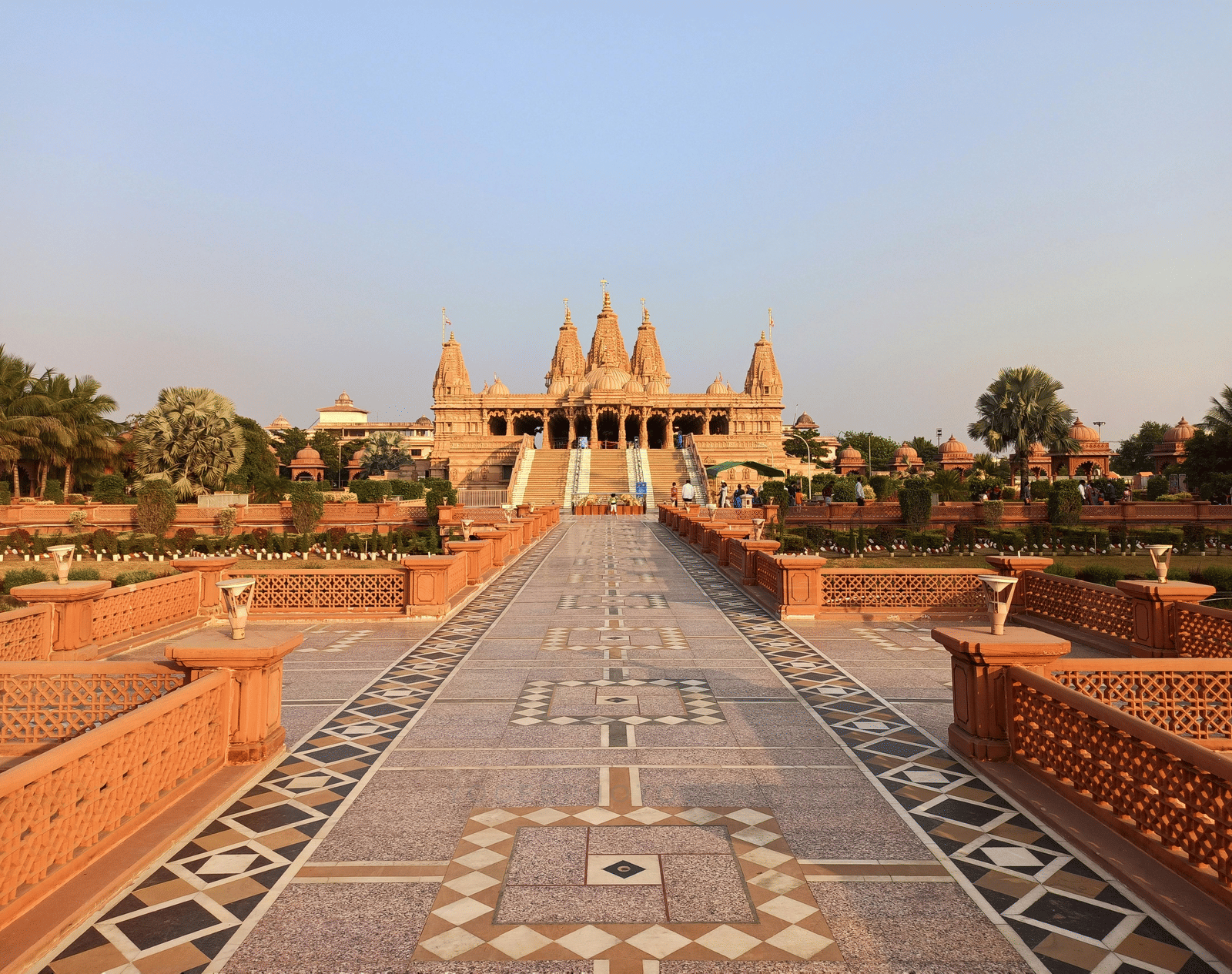
Opened in 2005, Akshardham is a sprawling temple complex dedicated to Bhagwan Swaminarayan. The main monument, carved from Rajasthani pink sandstone and Italian Carrara marble, features 234 ornate pillars, 9 domes, and over 20,000 sculpted figures. The complex includes exhibitions, gardens, and an evening musical fountain show.
  • Entry: Free (exhibitions and fountain show ticketed separately)
  • Timings: 9:30 a.m. to 6:30 p.m. (closed Mondays)
  • Best Time to Visit: Allow at least 3 hours; arrive by 4:00 p.m. for the fountain show

Colonial and Modern Landmarks

India Gate

Designed by Sir Edwin Lutyens and completed in 1931, India Gate is a 42 m war memorial commemorating the soldiers of the British Indian Army who died in World War I. The Amar Jawan Jyoti, an eternal flame, burns beneath the arch. The surrounding lawns are a popular gathering spot for evening picnics.
  • Entry: Free
  • Timings: Open 24 hours
  • Best Time to Visit: Evening for illuminated views and street food

Facade of the India Gate in New Delhi with a bright morning sky featuring the sun rising in the background.

Markets and Cultural Experiences

A man pedaling a cycle rickshaw on a paved path with several other rickshaws parked nearby against a backdrop of historic red sandstone buildings.

Chandni Chowk

Established by Shah Jahan in 1650, Chandni Chowk remains one of India's oldest and busiest wholesale markets. The narrow lanes specialise in spices, textiles, jewellery, and electronics. The area is equally famous for its street food: paranthas at Paranthe Wali Gali, jalebis at Old Famous Jalebi Wala, and chaat at countless stalls.
  • Best Time to Visit: Morning for shopping; evening for street food
  • Tip: Explore on foot or by cycle rickshaw; the lanes are too narrow for cars

Connaught Place

Built in the 1930s and named after the Duke of Connaught, this Georgian-style collonaded complex forms the commercial heart of New Delhi. The inner, middle, and outer circles house flagship stores, restaurants, and offices. Janpath Market, adjacent to the outer circle, offers handicrafts, clothing, and souvenirs.
  • Best Time to Visit: Late afternoon through evening for shopping and dining
  • Tip: Central Park in the middle of the complex is a quiet respite between shopping sprees

A distant view of the circular Parliament House building in New Delhi with green trees and a wide roadway in the foreground.

Practical Tips for Visiting Tourist Spots in New Delhi

  • Best Season: October to March. Summers (April to June) are extremely hot, and monsoons (July to September) bring humidity and occasional flooding.
  • Getting Around: The Delhi Metro connects most major tourist places in New Delhi. Auto-rickshaws and app-based cabs are convenient for shorter distances.
  • Dress Code: Modest clothing is expected at religious sites. Shoes must be removed before entering temples.
  • Photography: Photography is permitted at most monuments. Tripods and drones may require special permission.

Premium Rooms near Nehru Place at The Meriton, featuring a sleeping area with a large king size bed and an adjoining sitting area with a chaise lounge.

Where to Stay: The Meriton near Lotus Temple

After a day navigating the lanes of Chandni Chowk or photographing Humayun's Tomb at golden hour, the right hotel makes all the difference. The Meriton sits just 500 m from the Lotus Temple and approximately 3 km from Nehru Place, with Okhla NSIC Metro Station within walking distance.

The Meriton offers rooms ranging from 285 sq. ft. Standard Rooms suited to business travellers, to the 950 sq. ft. Presidential Suite for families or extended stays. Every room includes complimentary Wi-Fi, Smart TVs, and daily bottled water. Dining options span Bayleaf Restaurant for multi-cuisine buffets and à la carte meals.

New Delhi rewards the curious traveller with layers of history at every turn. From the sandstone ramparts of the Red Fort to the marble petals of the Lotus Temple, the capital's landmarks tell the story of empires, independence, and a nation constantly reinventing itself.

Rooms | Dining | Location | Contact Us

FAQs

What are the must-visit tourist attractions in New Delhi for first-time visitors?
First-time visitors should prioritise the Red Fort, Humayun's Tomb, Qutub Minar, India Gate, and the Lotus Temple. These 5 landmarks cover Mughal, Sultanate, colonial, and modern architectural styles and can be visited across 2 days with efficient planning.
 
What is the best time of year to visit tourist spots in New Delhi?
October to March offers the most comfortable weather for sightseeing, with clear skies and daytime temperatures between 15°C and 25°C. Avoid April to June when temperatures regularly exceed 40°C.

How many days are needed to explore tourist places in New Delhi?
A minimum of 3 days allows comfortable coverage of major monuments, markets, and temples. Visitors with specific interests in museums, street food, or day trips to Agra may wish to extend to 5 days.

Is the Delhi Metro convenient for visiting tourist attractions in New Delhi?
The Delhi Metro is the most efficient way to travel between major sites. Stations serve the Red Fort (Chandni Chowk), India Gate (Central Secretariat), Qutub Minar (Qutub Minar), Lotus Temple (Kalkaji Mandir), and Akshardham (Akshardham).

Are there any free tourist spots in New Delhi?
India Gate, the Lotus Temple, and Akshardham Temple (main complex) are free to enter. Chandni Chowk and Connaught Place are open markets requiring no entry fee. Many monuments offer free entry for children under 15.

What should I wear when visiting temples and monuments in New Delhi?
Modest clothing covering shoulders and knees is recommended for religious sites. Comfortable walking shoes are essential, as many monuments require extensive walking on uneven surfaces. Head coverings may be required at certain sites.

Where should I stay when visiting tourist attractions in New Delhi?
The Meriton near Lotus Temple offers an ideal base for exploring New Delhi's landmarks. Located just 500 m from the Lotus Temple and near Okhla NSIC Metro Station, the hotel provides spacious rooms, multiple dining options including a multi-cuisine restaurant, free parking, and a travel desk to arrange sightseeing.

Continue your booking